1 Fuzhou University2 University of Science and Technology of China* Corresponding author
PaperCode
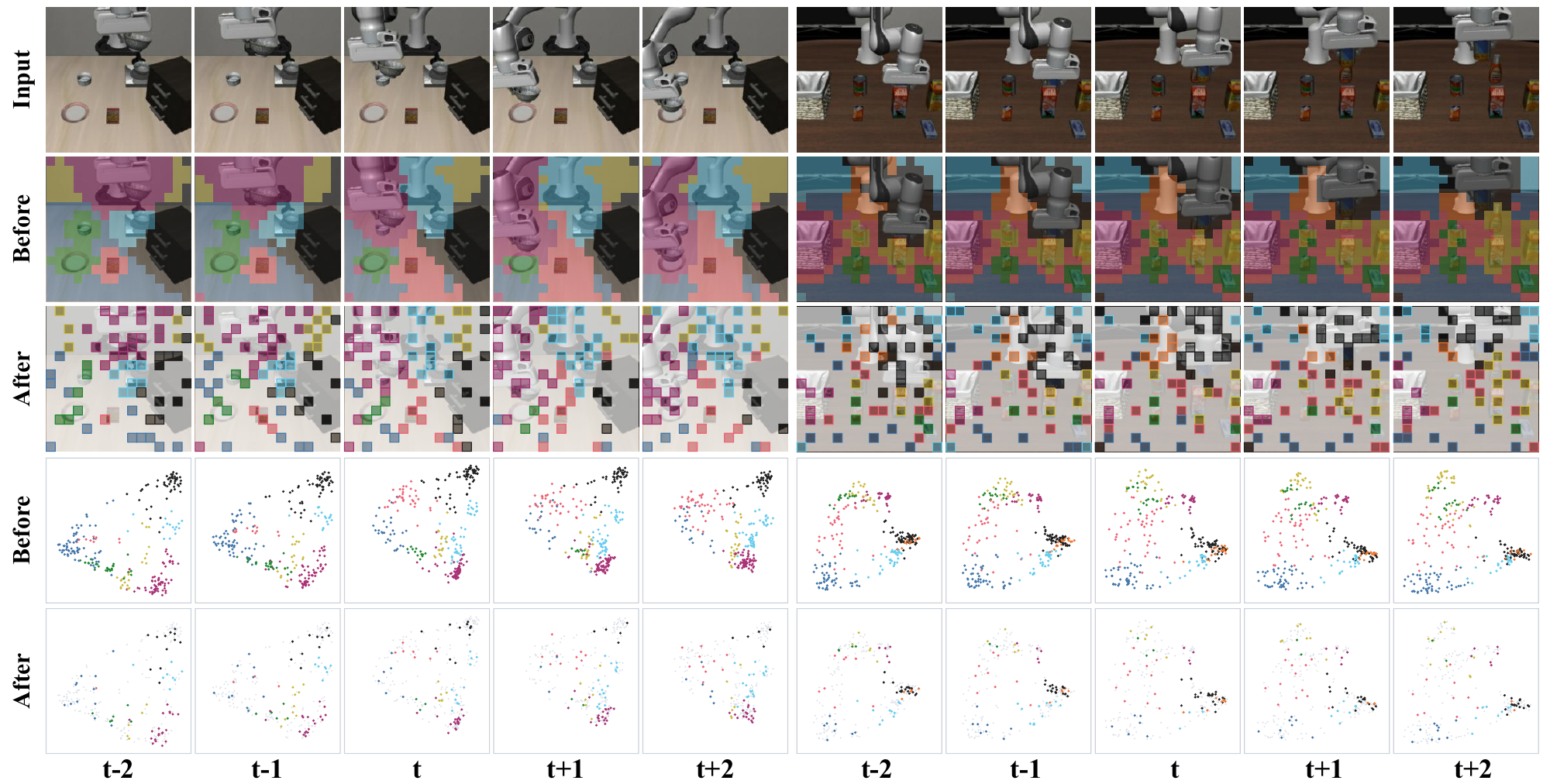
Preserving semantic structure with fewer visual tokens. TauPrune-VLA adapts the scale of perceptual representations as a manipulation scene evolves.
TL;DR
TauPrune-VLA is a training-free token pruning method that adapts perceptual selection through a single temperature τ. Online scale adaptation and asynchronous pruning deliver up to 1.86× inference speedup while maintaining near-baseline task success.
THE RESEARCH
Abstract
Vision-language-action (VLA) models must process continuous streams of visual observations, and the resulting computational cost limits real-time robotic control. Token pruning reduces this cost, but a fixed semantic scale of perceptual representation can overlook information needed at different stages of manipulation. We show that perceptual semantics can guide effective token selection without relying on internal attention when the selection scale adapts to the scene's evolving semantic structure. Based on this observation, we introduce TauPrune-VLA, a training-free method that controls the scale of the retained perceptual representation through a single perception temperature τ. To adapt this scale as manipulation proceeds, TauPrune-VLA updates τ online using trends in perceptual semantics, with robot-state changes and action magnitude regulating the adjustment strength. While these semantics evolve over the course of manipulation, they remain relatively stable between consecutive frames. This continuity allows retention indices computed from the current observation to be applied at the next policy invocation, enabling token selection to run asynchronously with inference and reducing pruning overhead. Evaluated across diverse VLA models and simulation benchmarks, TauPrune-VLA achieves up to a 1.86× inference speedup while maintaining near-baseline task success rates. We further validate its effectiveness on two real-world robotic platforms.
KEY OBSERVATION
The right tokens depend on the right scale.
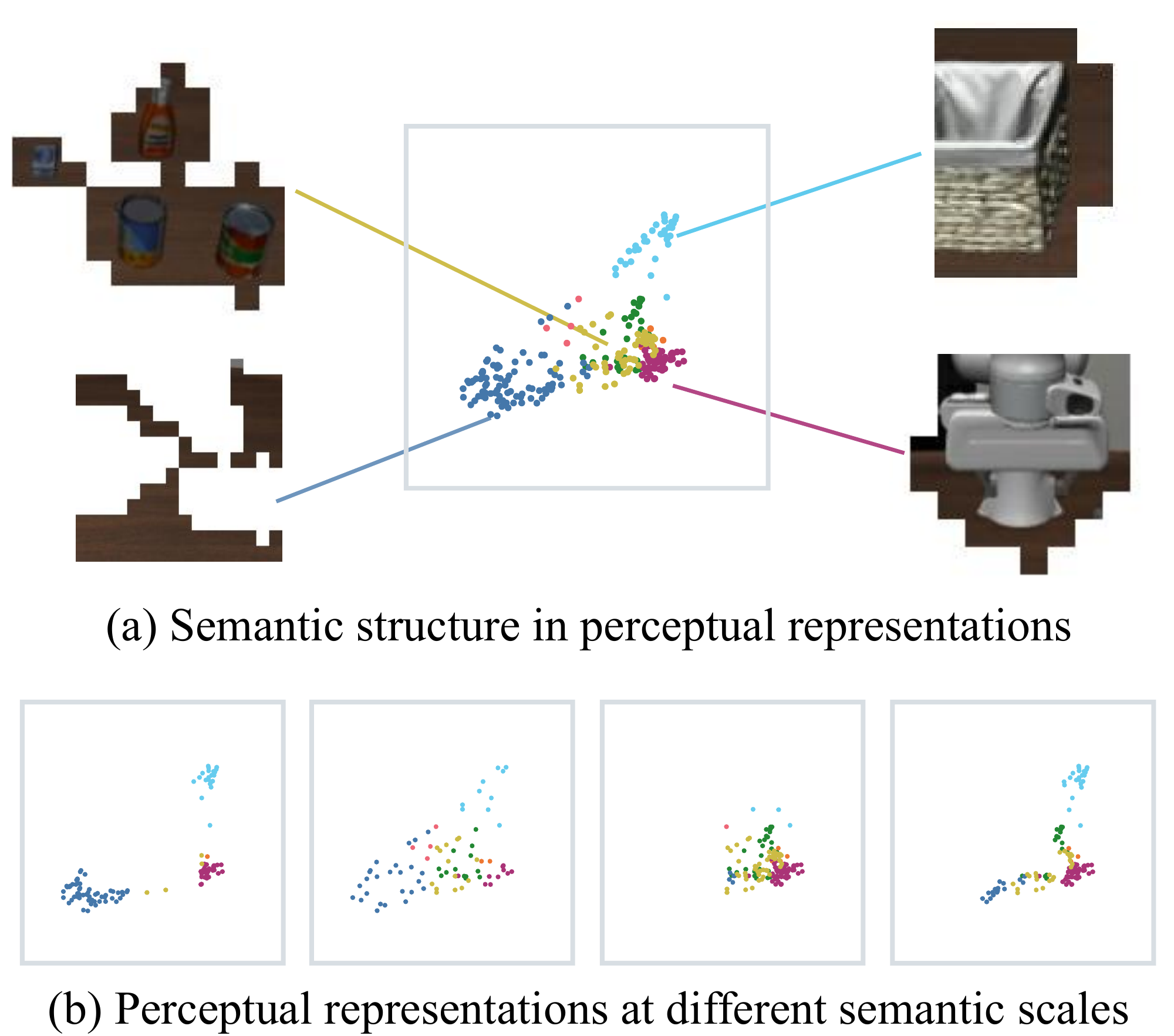
Visual features form semantic structures of very different sizes. Under a fixed token budget, selection must balance coverage across clusters with fidelity within each cluster.
A scale that suits one observation may become unsuitable as the robot moves. TauPrune-VLA follows these changes instead of fixing the selection scale throughout a task.
Perception-based selectionSelect tokens directly from visual feature structure, without internal attention scores.
Online scale adaptationUse perceptual trends to set the direction of temperature updates, and motion intensity to regulate their magnitude.
Asynchronous executionCompute retention indices in advance and reuse them at the next policy invocation.
HOW IT WORKS
Scale-Adaptive Token Pruning
A single perception temperature connects token selection to the evolving semantic structure of the scene.
Perceptual token selection
Each candidate token is scored by the representation gain it provides to the current retained set. The perception temperature τ adjusts the contribution of local gains, allowing the selector to operate at different semantic scales.
Gτ(j | S) = [ 1N ∑i=1N ([ri(S) − dij]+)1/τ ]τ
Perception–action temperature modulation
Trends in kernel spectral entropy and purity determine the direction of each temperature update. Robot-state changes and action magnitude regulate its strength, with smoothing and bounds keeping the temperature stable.
Prune ahead of the next policy call
Retention indices computed from the current observation are reused at the next policy invocation, allowing token selection to run asynchronously with inference. By default, pruning is applied after the second decoder layer.
RESULTS & EVALUATION
Simulation Experiments
Evaluation across OpenVLA-OFT, π0.5, and CogACT on LIBERO and SIMPLER.
Evaluation protocol. NVIDIA A40 GPU. FLOPs and latency include the acceleration procedure and the VLA prefill stage. Speedup is measured relative to the corresponding unaccelerated model.
LIBERO
Spatial · Object · Goal · Long
OpenVLA-OFT on LIBERO
Method
Success rate (%) ↑
FLOPs (T) ↓
Latency (ms) ↓
Speedup ↑
Spatial
Object
Goal
Long
Average
Vanilla
98.2
97.8
96.6
94.8
96.85
3.97
122.57
1.00×
FastV
98.6
97.6
95.2
89.6
95.25
1.56
62.92
1.95×
VLA-Cache
98.4
96.8
96.2
95.0
96.60
3.09
114.55
1.07×
VLA-Pruner
98.4
98.2
96.4
92.2
96.30
2.12
82.28
1.49×
DivPrune
98.4
97.0
97.2
88.2
95.20
1.56
69.34
1.77×
MMTok
97.8
97.6
95.4
93.0
95.95
1.56
73.49
1.67×
VLA-ADP
97.0
96.6
95.6
85.2
93.60
2.87
93.11
1.32×
SAFE-Pruner
98.8
98.8
96.4
90.4
96.10
1.84
96.01
1.28×
SpecPrune-VLA
98.6
97.8
97.6
91.0
96.25
1.51
86.26
1.42×
TauPrune-VLA
98.2
97.6
98.0
94.6
97.10
1.56
65.82
1.86×
π0.5 on LIBERO
Method
Success rate (%) ↑
FLOPs (T) ↓
Latency (ms) ↓
Speedup ↑
Spatial
Object
Goal
Long
Average
Vanilla
98.8
98.0
98.2
93.8
97.20
1.99
67.04
1.00×
FastV
81.8
95.2
91.4
74.4
85.70
1.27
37.31
1.80×
VLA-Cache
98.2
98.0
98.8
90.0
96.25
1.87
61.41
1.09×
VLA-Pruner
97.6
98.6
98.2
91.4
96.45
1.41
50.19
1.34×
DivPrune
96.2
98.4
96.8
90.0
95.35
1.27
44.92
1.49×
MMTok
96.6
97.2
97.4
92.4
95.90
1.27
48.34
1.39×
VLA-ADP
98.2
97.6
97.4
88.8
95.50
1.64
50.69
1.32×
SAFE-Pruner
92.0
98.0
95.0
85.0
92.50
1.50
54.48
1.23×
SpecPrune-VLA
97.4
94.6
95.8
90.0
94.45
1.19
55.42
1.21×
TauPrune-VLA
97.6
98.4
98.8
92.0
96.70
1.27
38.87
1.72×
TauPrune-VLA retains 25% of visual tokens on LIBERO. On OpenVLA-OFT, it reaches 97.10% average success with 65.82 ms latency. On π0.5, it achieves 96.70% average success with 38.87 ms latency.
SIMPLER
FROM SIMULATION TO PHYSICAL ROBOTS
Real-World Experiments
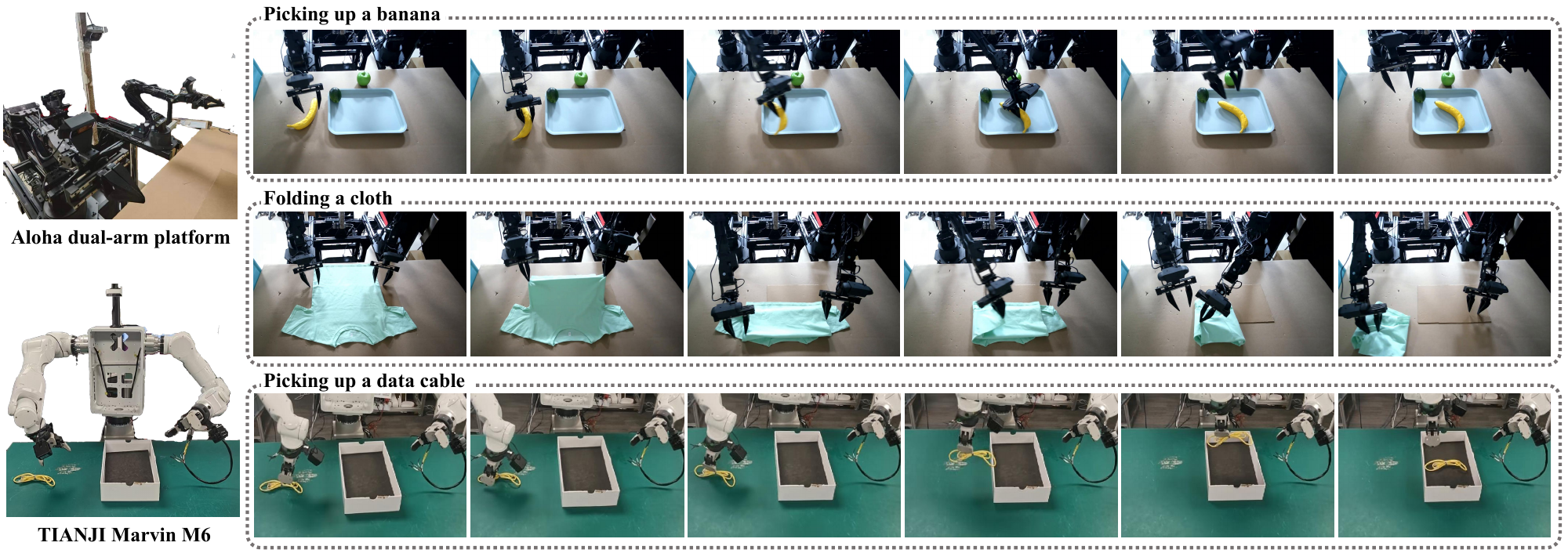
Validation on the Aloha dual-arm platform and TIANJI Marvin M6, with 30 trials per task.
Real-robot platforms and task execution. π0.5 with TauPrune-VLA performs banana picking, cloth folding, and cable picking. Shown here are execution snapshots from the manuscript.
Aloha dual-arm platform
Successful trials / 30
PickBanana and FoldCloth
Method
PickBanana ↑
FoldCloth ↑
FLOPs (T) ↓
Latency (ms) ↓
Speedup ↑
OpenVLA-OFT
28/30
6/30
7.73
183.80
1.00×
+ TauPrune-VLA
29/30
5/30
3.99
110.72
1.66×
π0.5
29/30
26/30
1.99
70.31
1.00×
+ TauPrune-VLA
29/30
26/30
0.92
45.70
1.54×
TIANJI Marvin M6
Successful trials / 30
PickCable
Method
PickCable ↑
FLOPs (T) ↓
Latency (ms) ↓
Speedup ↑
π0.5
26/30
1.99
76.60
1.00×
+ TauPrune-VLA
24/30
0.92
58.69
1.31×
On Aloha, π0.5 preserves the same success counts with 1.54× faster inference. Cable picking is more challenging: TauPrune-VLA accelerates inference by 1.31×, with 24/30 successes compared with 26/30 for the baseline.
BibTeX
Provisional manuscript citation. Publication details will be added when available.
@unpublished{lin_tauprune_vla,
  title  = {Perception Is Enough, at the Right Scale:
            Scale-Adaptive Token Pruning for Vision-Language-Action Models},
  author = {Lin, Yifeng and Qiu, Liuxiang and Chen, Yunfeng and Zhao, Tiesong},
  note   = {Manuscript}
}